

The 5-Part AI Prompt Formula That Makes AI Actually Understand You
If you've ever thought, "AI doesn't understand what I'm asking," you're not alone.
The reality is simple: AI performs best when your prompt is structured clearly. Instead of giving one vague instruction, provide AI with enough context to understand your intent.
A simple framework can dramatically improve the quality of responses.
Welcome to Day 2 of our AI Prompt Engineering Series. Today we're learning the 5-Part Prompt Formula that helps AI generate more accurate, relevant, and useful results.
Why Most AI Prompts Fail
Many users write prompts like:
"Create a marketing plan."
This sounds clear—but it's missing important information.
AI doesn't know:
- What kind of marketing?
- Who is the audience?
- What's the goal?
- What format do you want?
- Without context, AI fills in the gaps with assumptions.
The solution is a structured prompt.
The 5-Part Prompt Formula
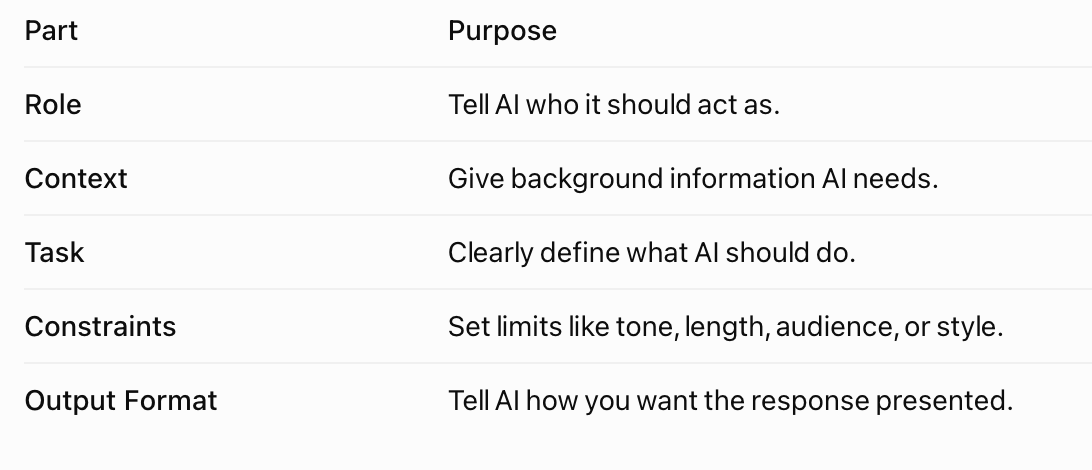
PART 1
- Role
- Tell AI who it should act as.
PART 2
- Context
- Give relevant background information.
PART 3
- Task
- Clearly define what you want AI to do.
PART 4
- Constraints
- Set limits for tone, length, audience, or style.
PART 5
- Output Format
- Specify exactly how you want the response presented.
Part 1: Role — Tell AI Who It Should Be
Start by assigning AI a role or persona.
Think of AI as a professional you're hiring for a job.
Examples
SEO Expert
Content Strategist
Senior Software Developer
Marketing Consultant
Career Coach
Instead of:
Explain SEO.
Try:
Act as an SEO expert and explain SEO to a beginner.
Giving AI a role helps it respond with the right perspective and expertise.
Part 2: Context — Give AI the Background
Context tells AI what it needs to know before completing the task.
Include details like:
Topic or industry
Target audience
Business or project background
Current situation
Goals or limitations
Example Context
I run a digital marketing agency that helps small businesses grow through social media.
Now AI understands the business environment before generating content.
More context = More relevant responses.
Part 3: Task — Clearly Define the Job
Now explain exactly what you want AI to do.
Good Tasks
Write a blog post.
Summarize an article.
Create a marketing plan.
Generate 10 Instagram caption ideas.
Translate this content into simple English.
Be specific about the desired outcome.
Weak Prompt
Help me with marketing.
Better Prompt
Create a 30-day Instagram marketing plan for a fashion brand.
Part 4: Constraints — Set Clear Boundaries
Constraints improve quality by reducing ambiguity.
Examples include:
Constraint Type
Example Length Maximum 200 words.
Tone
Friendly, professional, or conversational.
Audience
Beginners, students, marketers, or business owners.
Language
Simple English with no technical jargon.
Region
Focus on the Indian market.
Example
Write in beginner-friendly language under 250 words.
This prevents overly long or overly technical responses.
Part 5: Output Format — Tell AI How to Present the Answer
Don't leave formatting to chance.
Ask AI for exactly the structure you need.
Examples
- Bullet points
- Comparison table
- Instagram carousel
- Step-by-step guide
- Checklist
- Email template
- LinkedIn post
Example
Present the answer as a comparison table with pros and cons.
A clear output format saves editing time and makes content easier to use.
The Complete Prompt Formula
Here's what a complete prompt looks like:
Role
Act as a career coach.
Context
I'm a college student preparing for my first marketing job.
Task
Create a 30-day preparation plan.
Constraints
Keep it beginner-friendly with practical daily tasks.
Output Format
Present it in a table with Day, Activity, and Goal.
This single prompt gives AI everything it needs to deliver a focused, actionable response.
Before vs After
Weak Prompt —> "Write about AI."
Strong Prompt —>
"Act as a content strategist. Write a 200-word LinkedIn post explaining AI prompts for beginners in a friendly tone and end with a question."
"Create a marketing plan."
"Act as a digital marketing consultant. Create a 30-day Instagram marketing plan for a local café in India. Present it in a weekly table."
Notice how the stronger prompts produce responses that are easier to publish with minimal editing.
Quick Prompt Checklist
Before sending a prompt to AI, ask yourself:
- Did I assign a Role?
- Did I provide enough Context?
- Did I clearly define the Task?
- Did I include Constraints like tone or length?
- Did I specify the Output Format?
If the answer is "yes" to all five, your AI prompt is much more likely to generate high-quality results.
Final Takeaway
- Don't just ask AI questions—guide it like a skilled assistant.
- The 5-Part Prompt Formula transforms vague prompts into precise instructions that produce better content, better ideas, and better productivity.
- Use this framework every time you work with ChatGPT or any AI tool, and you'll notice an immediate improvement in response quality.