

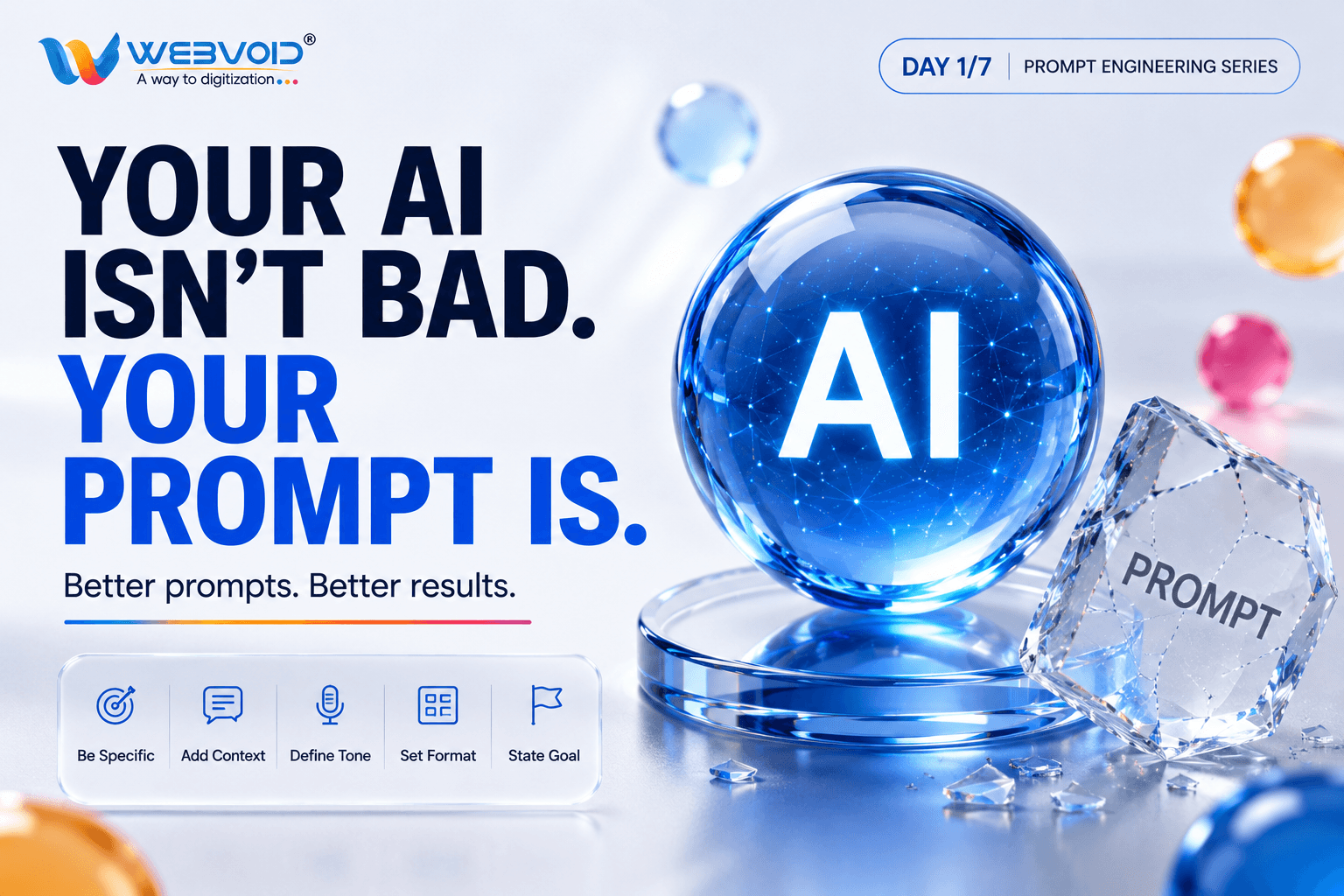
Your AI Isn't Bad. Your Prompt Is.
The biggest mistake people make with AI isn't using the wrong tool—it's using the wrong prompt.
If you've ever asked ChatGPT, Gemini, or Claude a question and received a generic or disappointing answer, you've probably blamed the AI. In reality, AI usually responds based on the quality of the instructions it receives. Better instructions lead to better results.
Welcome to Day 1 of Webvoid's 7-Day Prompt Engineering Series, where you'll learn how to communicate with AI like a professional.
Why AI Gives Bad Answers
Imagine asking a designer, "Make me something nice."
You'll probably get something, but it may not match your expectations.
Now imagine saying, "Design a modern Instagram carousel for beginners about AI using blue glassmorphism, minimal design, and six slides."
The second request is clear, specific, and easy to execute.
AI works exactly the same way.
A vague prompt forces AI to guess your intent. A specific prompt gives it direction.
The Real Problem Isn't AI
Most users think AI is inaccurate because it doesn't understand them. The truth is that AI often lacks the context needed to generate the right response.
Instead of asking broad questions, provide information about:
Who the content is for.
What you want AI to create.
How you want it written.
What outcome you're expecting.
Clear prompts remove ambiguity.
Bad Prompt vs Better Prompt
Bad Prompt
"Write a post about AI."
This prompt doesn't mention the audience, tone, format, length, or purpose. AI has to make assumptions.
Better Prompt
"Write an Instagram post explaining AI to beginners using simple language. Start with a strong hook, include one real-world example, keep it under 200 words, and end with a question."
Now AI knows exactly what success looks like.
The Five Ingredients of a Great Prompt
1. Audience
Tell AI who you're speaking to.
Examples include beginners, students, developers, founders, marketers, or HR professionals.
2. Goal
Explain what you want AI to accomplish.
Examples include teaching, summarizing, brainstorming, comparing, selling, or creating content.
3. Tone
Choose the writing style.
Examples include professional, friendly, conversational, technical, motivational, or humorous.
4. Format
Specify how you want the output.
Examples include blog, LinkedIn post, Instagram carousel, checklist, email, JSON, or table.
5. Constraints
Set clear boundaries.
Examples include word limit, reading level, number of points, examples to include, or ending with a CTA.
Use This Prompt Formula Everywhere
A simple formula that works with almost every AI assistant is:
Role → Task → Context → Constraints → Output Format
Example:
You are a content strategist. Write an Instagram carousel explaining prompt engineering to beginners using simple English, one real-life example, under 250 words, with a CTA at the end.
This formula works across ChatGPT, Gemini, Claude, and most modern AI tools.
Treat AI Like an Assistant
Don't think of AI as a search engine.
Think of it as someone helping you complete a task.
Instead of saying:
"Explain marketing."
Say:
"Explain digital marketing to a beginner using three simple real-world examples in under 200 words."
The clearer your instruction, the more useful the answer becomes.
Real Prompt Examples
Writing
Bad: Write an email.
Better: Write a professional follow-up email after a job interview. Keep it polite, confident, and under 120 words.
Coding
Bad: Fix my React code.
Better: Debug this React component, explain the issue, provide corrected code, and briefly explain why the fix works.
Learning
Bad: Teach me AI.
Better: Teach me AI like I'm a first-year engineering student using simple analogies and practical examples.
Business
Bad: Give startup ideas.
Better: Suggest 10 AI SaaS startup ideas for students in India that can be built using React, FastAPI, and OpenAI APIs on a low budget.
Common Prompt Mistakes
Asking questions without context.
Mixing multiple unrelated requests into one prompt.
Forgetting to define the audience.
Not specifying the output format.
Ignoring tone, length, or constraints.
Avoiding these mistakes instantly improves AI responses.
Prompt Checklist Before You Press Enter
Ask yourself:
Is the audience clear?
Is the goal clear?
Is the tone specified?
Is the format specified?
Are there clear constraints?
If the answer is yes to all five, your prompt is already stronger than most prompts people use.
Key Takeaways
AI isn't bad—unclear prompts are.
Specific prompts consistently produce better outputs than vague prompts.
Give AI context, purpose, tone, format, and constraints.
Think of prompt engineering as giving instructions to a smart assistant, not asking random questions.
Don't just ask AI. Tell it exactly what you need.