

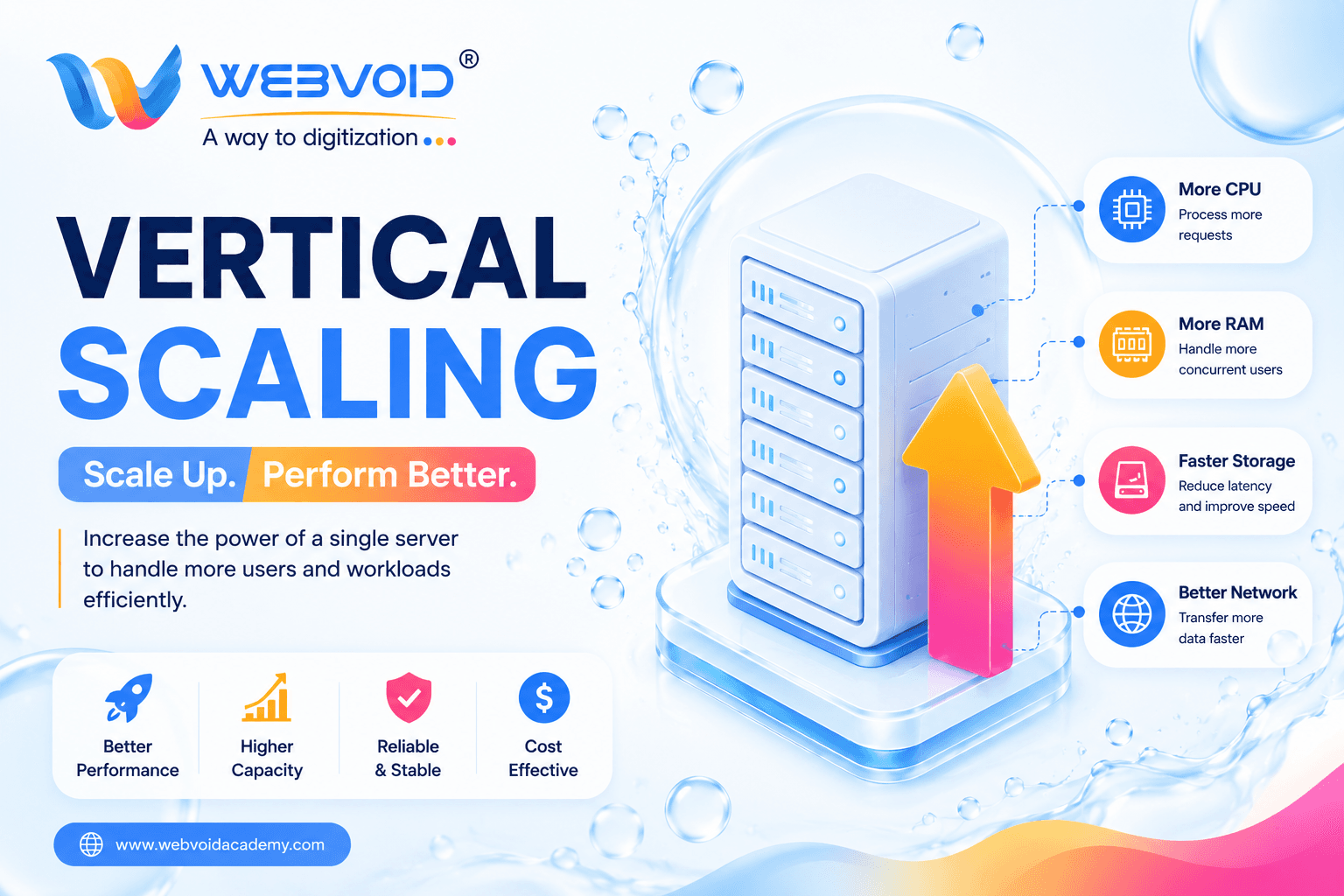
Vertical Scaling Explained: The First Step to Scaling Your Application
Every successful application starts with a single server. Whether you're building a startup SaaS platform, an e-commerce website, an enterprise application, or an AI-powered service, your application initially runs on one machine. During the early stages, this setup is more than enough to handle incoming traffic efficiently.
However, as your product grows, so does the number of users accessing your application. The server now has to process more API requests, handle additional database queries, manage larger datasets, authenticate thousands of users, and execute numerous background tasks simultaneously. Eventually, the workload exceeds the server's capacity, leading to slower response times, increased latency, and a poor user experience.
One of the simplest and fastest ways to improve application performance without redesigning the entire architecture is Vertical Scaling.
What is vertical scaling
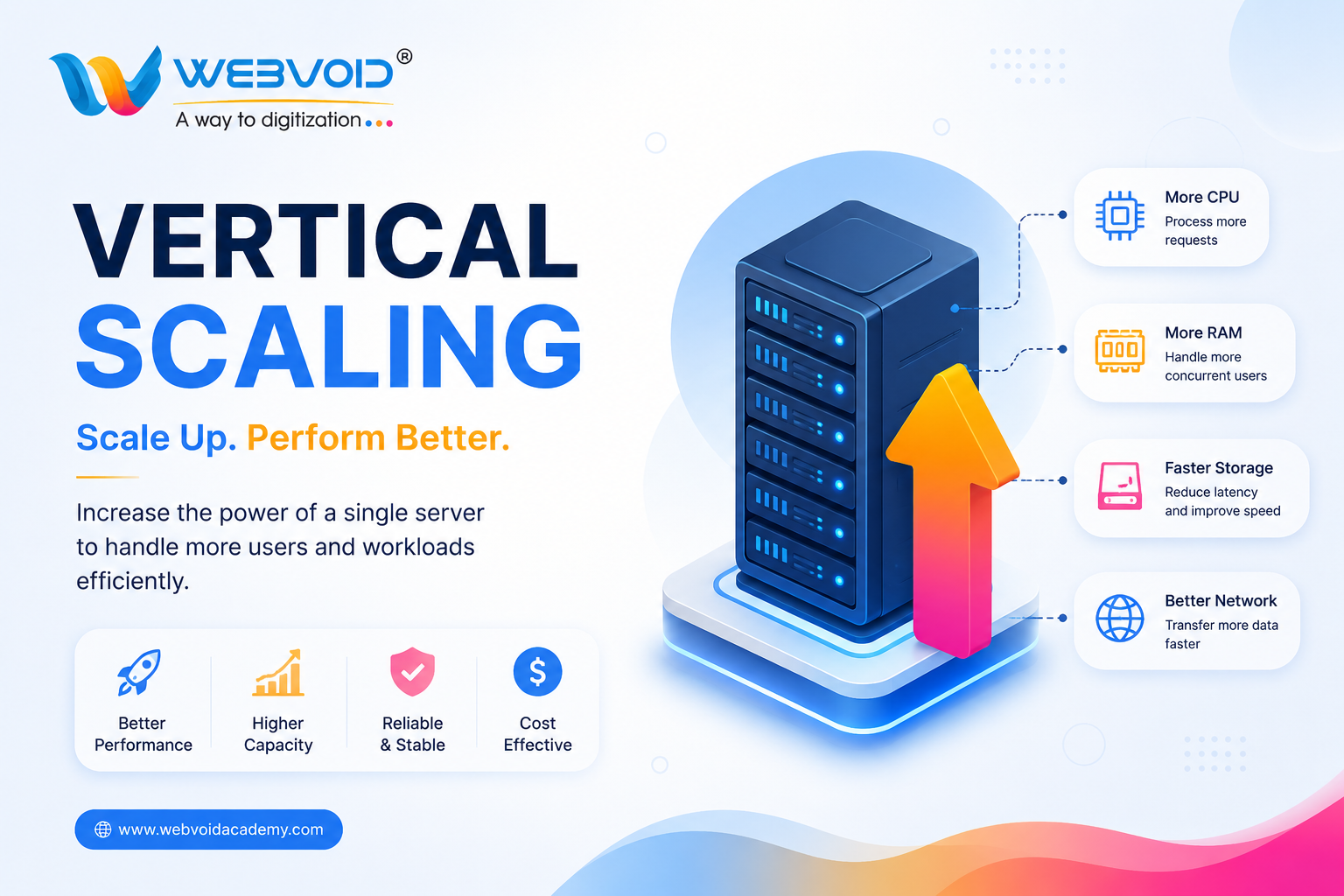
Vertical Scaling, also known as Scale Up, is the process of increasing the hardware resources of an existing server rather than adding more servers.
Instead of distributing traffic across multiple machines, engineers make the current server more powerful by upgrading its hardware resources. This allows the same server to process more requests and handle larger workloads without changing the application's architecture.
Typical hardware upgrades include:
- Increasing CPU cores
- Increasing RAM
- Upgrading storage from HDD to SSD or NVMe SSD
- Increasing storage capacity
- Improving network bandwidth
The application continues to run on the same server, but with significantly more computing power.
Why do applications need vertical scaling?
Every application experiences growth over time. As the user base expands, the server is required to process an increasing number of operations simultaneously.
For every user visiting your application, the server performs multiple tasks such as:
- Processing API requests
- Executing business logic
- Running database queries
- Authenticating users
- Sending emails
- Processing images or videos
- Running scheduled background jobs
- Managing cache operations
As these operations increase, the server eventually reaches its resource limits.
Common signs that your application requires scaling include:
- High CPU utilization
- Memory exhaustion
- Slow API responses
- Increased request latency
- Database query delays
- Frequent application crashes
- Request timeout errors
Vertical Scaling helps solve these problems by providing additional computing resources to the server.
Understanding serve bottle necks
CPU Bottleneck
The CPU processes all application logic, including API requests, encryption, image processing, and business operations. When CPU usage stays above 90%, requests start waiting for processing, resulting in slower response times. Increasing CPU cores improves parallel processing and overall throughput.
Memory (RAM) Bottleneck
RAM stores active application data such as user sessions, cache, and runtime objects. When RAM is exhausted, the operating system starts swapping data to disk, which significantly slows down the application. Adding more RAM allows more data to stay in memory, improving performance.
Storage Bottleneck
Applications constantly perform disk operations like database queries, file uploads, and log generation. Traditional HDDs are slower under heavy workloads, while SSDs and NVMe SSDs provide much faster read/write speeds and lower latency.
Network Bottleneck
Applications that transfer large amounts of data, such as APIs, media platforms, or file services, can become limited by network bandwidth. Increasing bandwidth allows the server to handle more concurrent data transfers with lower latency.
How Vertical Scaling Works
Consider an application initially running on a server with the following configuration:
- 2 vCPUs
- 4 GB RAM
- 80 GB SSD
As the application grows and traffic increases, the engineering team upgrades the server to:
- 8 vCPUs
- 32 GB RAM
- 500 GB NVMe SSD
The application code remains exactly the same.
There is no need to redesign the architecture, introduce multiple servers, or configure a Load Balancer.
The server simply gains access to more computing resources, allowing it to process significantly more requests while maintaining good performance.
Vertical Scaling in Cloud Computing
Modern cloud providers make Vertical Scaling extremely simple through virtualization technologies.
Popular cloud platforms such as Amazon Web Services (AWS), Microsoft Azure, Google Cloud Platform (GCP), DigitalOcean, Oracle Cloud, and Linode allow engineers to resize virtual machines by allocating additional CPU cores, RAM, storage, and networking resources.
Instead of purchasing new physical hardware, organizations can upgrade their cloud instances within minutes, making Vertical Scaling a quick solution during sudden traffic spikes.
Real-World Example
Imagine an online shopping platform preparing for a festive sale.
Under normal conditions, the application serves around 3,000 users daily. During the sale, traffic suddenly increases to more than 80,000 users.
The application server begins showing several performance issues:
- CPU usage exceeds 95%
- Memory utilization reaches 100%
- API response times increase significantly
- Database queries become slower
- Customers experience delays while browsing products
Instead of redesigning the infrastructure overnight, engineers decide to vertically scale the application server.
The existing server with 2 vCPUs and 4 GB RAM is upgraded to a larger virtual machine containing 16 vCPUs and 64 GB RAM.
Immediately after the upgrade:
- API responses become faster
- Database queries execute more efficiently
- Background jobs complete quicker
- Overall user experience improves
This demonstrates how Vertical Scaling can quickly solve performance problems without changing the application's architecture.
Advantages of Vertical Scaling
One of the biggest advantages of Vertical Scaling is its simplicity.
Since the application continues running on a single server, no architectural modifications are required.
Cloud providers make upgrades straightforward, allowing organizations to increase server resources within minutes.
Maintenance also remains simple because engineers only need to monitor a single machine.
There is no need for additional infrastructure components such as Load Balancers, distributed caches, service discovery mechanisms, or clustering software.
For startups, MVPs, internal enterprise applications, and small business solutions, Vertical Scaling provides an efficient way to improve performance while keeping operational complexity low.
Limitations of Vertical Scaling
Despite its simplicity, Vertical Scaling has several important limitations.
The biggest limitation is the hardware ceiling. Every server has a maximum amount of CPU, RAM, storage, and network bandwidth that it can support. Once these limits are reached, no further upgrades are possible.
Another significant drawback is the Single Point of Failure (SPOF).
Since the entire application runs on one server, any hardware failure, operating system crash, or power outage causes the complete application to become unavailable.
Infrastructure costs also increase rapidly as larger servers become significantly more expensive than smaller machines.
Finally, Vertical Scaling cannot support applications requiring extremely high traffic or global availability. Applications serving millions of users eventually require multiple servers instead of one increasingly powerful server.
Vertical Scaling vs Horizontal Scaling
Vertical Scaling focuses on improving the performance of a single server by upgrading its hardware resources.
Horizontal Scaling takes a completely different approach by adding multiple servers and distributing traffic among them using a Load Balancer.
Vertical Scaling is easier to implement and requires minimal architectural changes, making it ideal for startups and small applications.
Horizontal Scaling provides high availability, fault tolerance, and virtually unlimited scalability, making it the preferred solution for large-scale production systems such as Netflix, Amazon, Google, and Uber.
When Should You Use Vertical Scaling?
Vertical Scaling is an excellent choice when:
- Your application is still in its early stages.
- Traffic is predictable.
- Operational simplicity is a priority.
- Budget constraints favour a single server.
- High availability is not yet required.
- Development teams want the fastest way to improve performance.
Many startups begin with Vertical Scaling before transitioning to more advanced distributed architectures.
When Vertical Scaling Is No Longer Enough
As applications continue growing, upgrading a single server eventually stops providing meaningful performance improvements.
Large-scale applications require:
- Multiple application servers
- Load Balancers
- Database replication
- Distributed caching
- Auto Scaling
- High Availability
- Fault Tolerance
At this stage, engineering teams transition to Horizontal Scaling, where workloads are distributed across multiple servers instead of relying on a single machine.
Best Practices for Vertical Scaling
Before upgrading your infrastructure, always monitor server metrics to identify the actual performance bottleneck.
Use monitoring and observability tools such as Prometheus, Grafana, Datadog, or New Relic to track CPU, memory, storage, and network utilization.
Upgrade resources incrementally instead of provisioning oversized servers immediately.
Benchmark application performance before and after each upgrade to measure the impact.
Finally, plan for Horizontal Scaling early if rapid business growth is expected, as every server has physical and economic limitations.
Conclusion
Vertical Scaling is one of the simplest and most effective strategies for improving application performance. By upgrading the CPU, memory, storage, and networking capacity of a single server, organizations can quickly support increasing workloads without modifying their application architecture.
While Vertical Scaling is an excellent solution for startups, MVPs, and small-to-medium applications, it is not a permanent scalability strategy. Every server has physical and financial limits, making it unsuitable for applications requiring high availability or the ability to serve millions of users.
Understanding Vertical Scaling is a fundamental concept for every software engineer, backend developer, cloud engineer, and system design enthusiast. It provides the foundation for designing scalable applications and serves as the first step toward building modern distributed systems.