

Introduction
Every successful application eventually reaches a point where upgrading a single server is no longer enough.
Initially, increasing CPU, RAM, and storage through Vertical Scaling works well. However, as user traffic continues to grow, every server eventually reaches its hardware limits. At this stage, simply purchasing a larger machine becomes expensive, introduces a single point of failure, and still doesn't guarantee continuous availability.
This is where Horizontal Scaling becomes essential.
Horizontal Scaling is the foundation of modern distributed systems and is used by companies like Netflix, Amazon, Google, Meta, Uber, and Spotify to serve millions of users every day.
Instead of making one server more powerful, Horizontal Scaling increases capacity by adding multiple servers that work together to handle incoming traffic.
What is Horizontal Scaling?
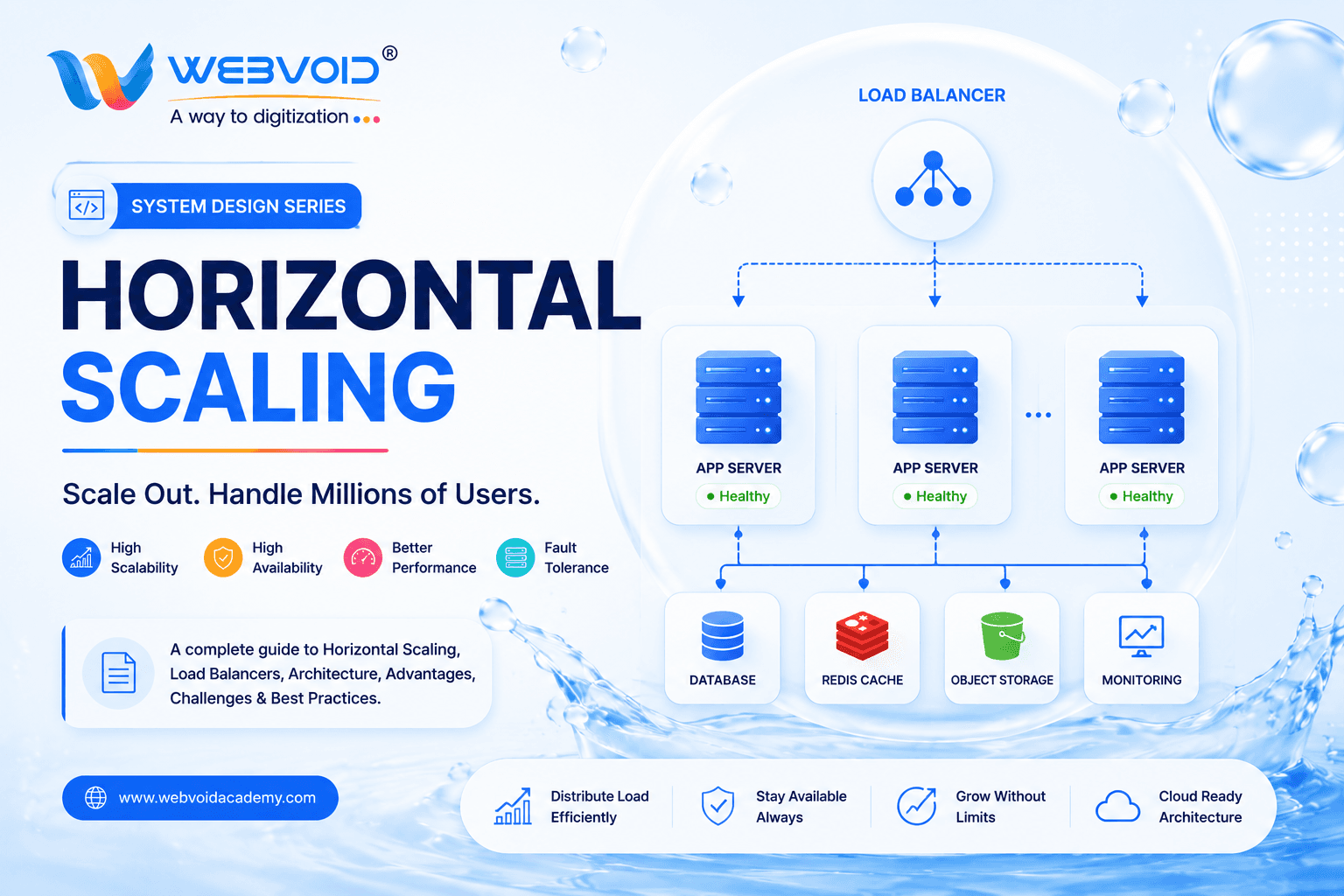
Horizontal Scaling, also known as Scale Out, is the process of increasing application capacity by adding more servers instead of upgrading a single server.
Rather than relying on one powerful machine, the application is deployed across multiple servers. Incoming requests are distributed among these servers using a Load Balancer, allowing the workload to be shared efficiently.
Each server runs the same application, enabling the system to process significantly more requests simultaneously.
Why Do We Need Horizontal Scaling?
Every server has physical limitations.
Regardless of how much CPU or RAM you add, a single machine eventually reaches its maximum capacity.
As applications continue growing, they must handle:
- Millions of users
- Thousands of requests per second
- High database traffic
- Large file uploads
- Background jobs
- Global users across multiple regions
A single server cannot reliably manage this workload.
Horizontal Scaling solves this problem by distributing requests across multiple servers, improving both performance and reliability.
How Horizontal Scaling Works
Consider an application running on a single server.
Initially:
- Users → Application Server
As traffic increases, a Load Balancer is introduced.
The architecture becomes:
Users → Load Balancer → Multiple Application Servers
When a request arrives:
- The user sends a request.
- The Load Balancer receives it.
- The Load Balancer selects the healthiest available server.
- The chosen server processes the request.
- The response is returned to the user.
Since requests are shared across multiple servers, no single machine becomes overwhelmed.
Role of the Load Balancer
A Load Balancer is the core component of Horizontal Scaling.
Its responsibilities include:
- Distributing incoming traffic
- Preventing server overload
- Performing health checks
- Detecting failed servers
- Routing requests only to healthy servers
- Improving response times
- Increasing application availability
Without a Load Balancer, traffic distribution would be difficult and inefficient.
Real-World Example
Imagine an online shopping platform during a major festive sale.
Under normal conditions, one server can comfortably handle 5,000 concurrent users.
During the sale, traffic suddenly increases to 200,000 concurrent users.
Instead of upgrading to an extremely expensive server, engineers deploy multiple application servers.
Architecture:
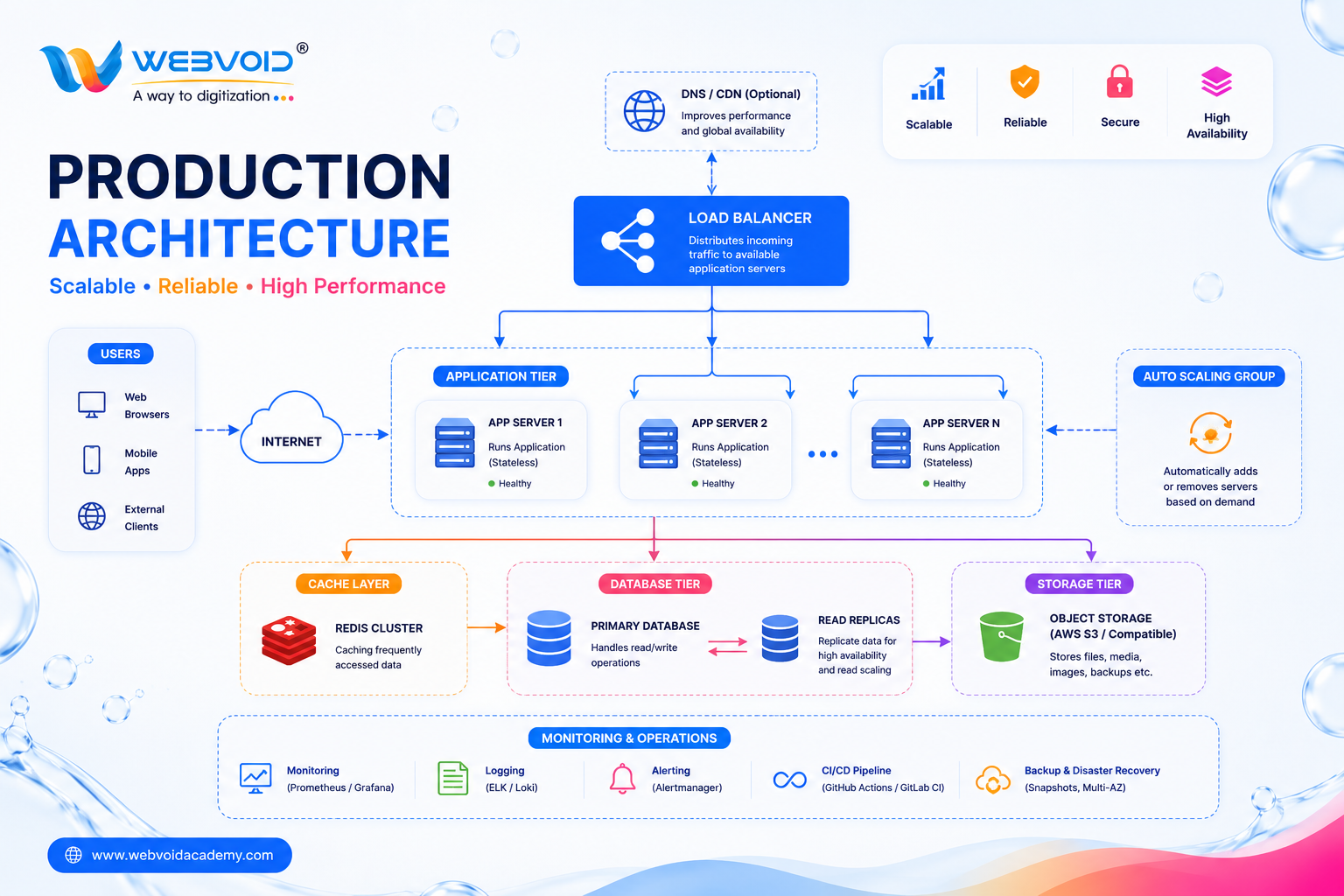
- 1 Load Balancer
- 10 Application Servers
- Shared Database
- Redis Cache
Each server handles only a fraction of the incoming requests.
As traffic grows further, additional servers can be added without affecting the existing infrastructure.
Advantages of Horizontal Scaling
Virtually Unlimited Scalability
Additional servers can be added whenever traffic increases.
Unlike Vertical Scaling, there is no practical hardware ceiling.
High Availability
If one server fails, other servers continue serving requests.
Users rarely notice individual server failures.
Better Fault Tolerance
Failures remain isolated.
A hardware failure affects only one server rather than the entire application.
Zero-Downtime Maintenance
Servers can be upgraded, restarted, or deployed individually while the application continues running.
Better Performance
Since traffic is distributed across multiple servers, response times remain consistent even during heavy traffic.
Cloud-Friendly
Modern cloud providers support automatic Horizontal Scaling through Auto Scaling Groups.
Servers are created automatically when demand increases and removed when demand decreases.
Challenges of Horizontal Scaling
Although Horizontal Scaling provides significant benefits, it also introduces additional complexity.
Load Balancer Configuration
Applications now require proper traffic routing.
Session Management
User sessions cannot remain stored locally on individual servers.
Instead, sessions are typically stored using:
- Redis
- Databases
- JWT Authentication
Database Scaling
The database may eventually become the next bottleneck.
Solutions include:
- Read Replicas
- Database Sharding
- Partitioning
Distributed Caching
Applications usually introduce Redis or Memcached to reduce database load.
Deployment Complexity
Multiple servers require:
- Automated deployments
- Health monitoring
- Logging
- Centralized configuration
- CI/CD pipelines
Production Architecture
Best Practices
When implementing Horizontal Scaling:
- Keep application servers stateless.
- Store sessions in Redis or use JWT authentication.
- Use Load Balancers with health checks.
- Monitor CPU, memory, and request latency.
- Implement Auto Scaling policies.
- Use centralized logging and monitoring tools.
- Cache frequently accessed data.
- Scale databases independently.
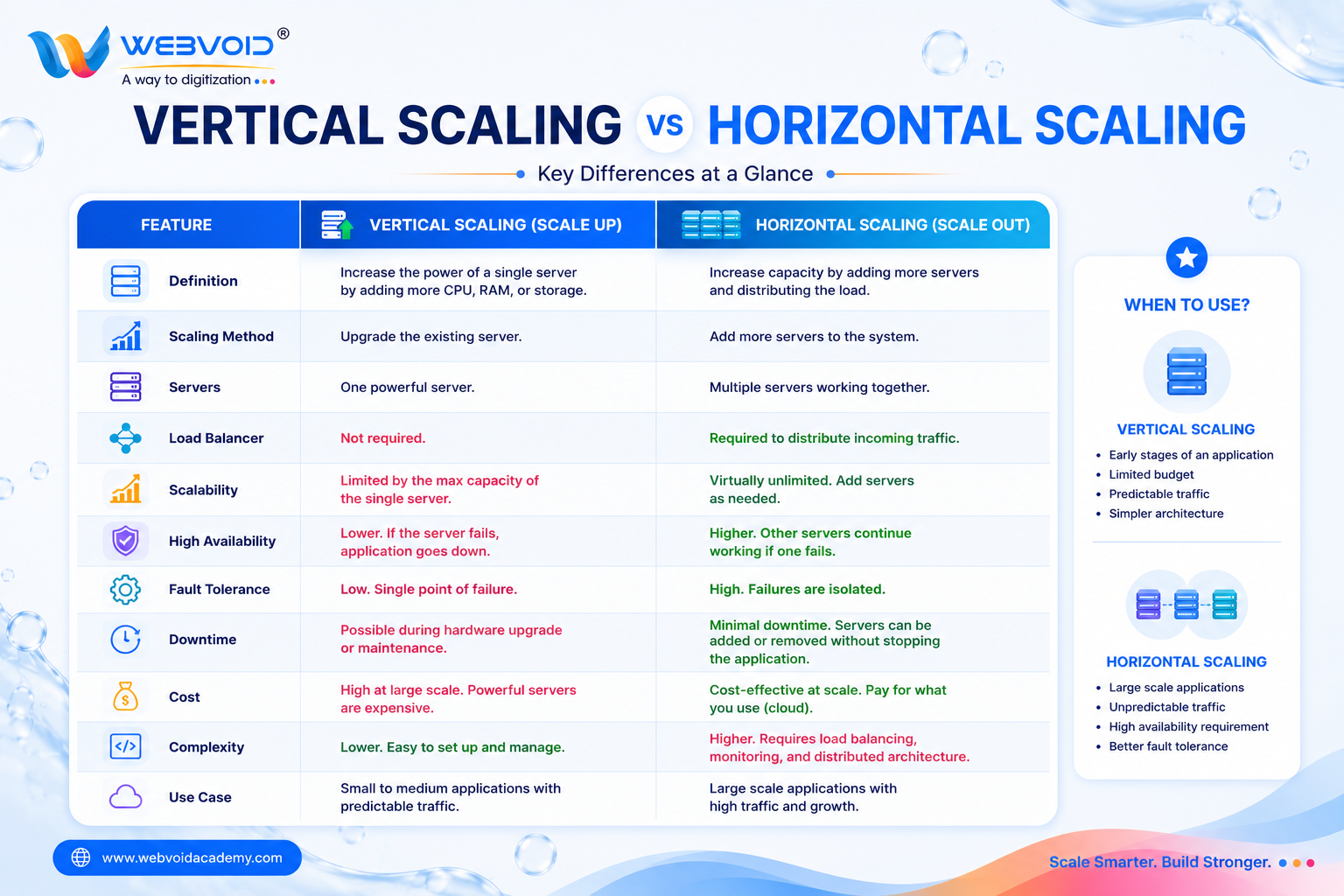
Differences between Horizontal Scaling and vertical Scaling
When Should You Use Horizontal Scaling?
Horizontal Scaling is recommended when:
- Your application serves thousands or millions of users.
- High availability is required.
- Downtime is unacceptable.
- You need fault tolerance.
- Traffic fluctuates significantly.
- Cloud Auto Scaling is available.
- Business growth is expected.
Real-World Companies Using Horizontal Scaling
Horizontal Scaling is used by almost every large technology company.
Examples include:
- Netflix
- Amazon
- Meta
- Uber
- Spotify
- Microsoft
These companies operate thousands of servers distributed across multiple regions to ensure their services remain available even during hardware failures or massive traffic spikes.
Conclusion
Horizontal Scaling is the standard approach for building highly available, fault-tolerant, and scalable applications. By distributing traffic across multiple servers behind a Load Balancer, organizations can handle millions of users while maintaining performance and reliability.
Although it introduces additional architectural complexity, Horizontal Scaling provides virtually unlimited scalability and forms the foundation of modern cloud-native applications.
Whether you're preparing for system design interviews or building production-ready software, understanding Horizontal Scaling is an essential skill for every backend engineer, cloud engineer, and software developer.